New Essay: ‘Cinematic Semiotic Excess: A Deleuzian Final Cut of All the Signs in the World’
‘Cinematic Semiotic Excess: A Deleuzian Final Cut of All the Signs in the World’ – David Deamer
in
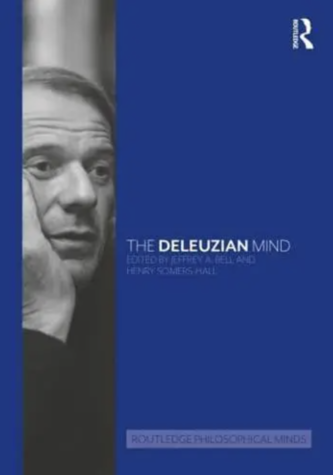
The Deleuzian Mind (Eds. Henry Somers-Hall, Jeffrey A. Bell: Routledge, 2025)
About the book:
Gilles Deleuze was one of the most influential philosophers of the second half of the twentieth century. As with other French philosophers of his generation, such as Jacques Derrida and Michel Foucault, Deleuze’s work and his collaboration with Félix Guattari has also had huge influence in other disciplines, particularly literature, film studies, architecture, and science and mathematics.
The Deleuzian Mind is an outstanding collection that explores the full extent and significance of Deleuze’s work, its reception and its legacy. Comprising 38 chapters written by an international and interdisciplinary team of contributors, the volume is divided into eight clear parts:
- Situating Deleuze
- A New History of Philosophy. Deleuze’s Precursors
- Encounters Critical and Clinical
- The Early Philosophy. A Logic of Sense
- The Later Philosophy. The Wasp and the Orchid
- Art and Literature
- Deleuze, Maths and Science
- Deleuze and Politics
With its wide-ranging exploration of Deleuze’s thought and the huge influence it continues to have within the theoretical humanities and social sciences, The Deleuzian Mind is invaluable reading for students, researchers and scholars in philosophy, literature, film studies and political theory.
About ‘Cinematic Semiotic Excess: A Deleuzian Final Cut of All the Signs in the World’:
This essay explores Gilles Deleuze’s practise of signs in Cinema 1: The Movement-Image (1983) and Cinema 2: The Time-Image (1985). The main sections cover the fundamental co-ordinates of a semiotic developed through cinema from Henri Bergson’s Matter and Memory (1896), then expanded as movement-images with Charles Sanders Peirce’s Pragmatism and Pragmaticism (1903) and time-images with Deleuze’s own Difference and Repetition (1968). Together, the movement-image and the time-image constitute a vast two-fold semiosis where the signs of the former cohere as continuity and the latter explode in discordance. For Deleuze, every film is composed of multiple signs, and so there is the possibility of a film being assembled from every movement-image and time-image. György Pálfi’s Final Cut: Ladies & Gentlemen (Final Cut: Hölgyeim és uraim | Hungary 2012) is such a film, and so captures and exposes the tension between the two tendencies of the cinematic image explored in the Cinema books. The argument is that this vast semiotic allowed Deleuze to conceive of what he called a classification of all the signs in the world; and consequently, the cineosis can be seen as one of Deleuze’s greatest philosophical achievements, an achievement only possible because of his encounter with the movies.