‘Nietzsche’s “comedy of existence” and Monty Python’s The Meaning of Life’
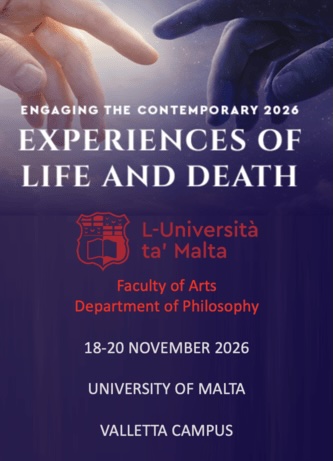
Engaging the Contemporary 2026: Experiences of Life and Death
Convened by the Department of Philosophy, University of Malta, Malta, 18-20 November 2026.
‘At present,’ writes Nietzsche, ‘we still live in the age of tragedy… the comedy of existence has not yet “become conscious” of itself’ (GS§1). This paper explores how the age of the comedy of existence is now upon us, a momentous contemporary cultural Weltanschauung, this condition having uses for life. To explore this claim, I look to the domain of comedy itself, taking as an incision point Monty Python (1969-onwards), which has inspired modern comedy writers from Groening (Simpsons) to Parker and Stone (South Park), from Tina Fey to Stewart Lee, to mention a few. Accordingly, I will put the Python’s last film, The Meaning of Life (1983), into conversation with the final book of Nietzsche’s free spirit series.
The Gay Science (1882/1887) is where Nietzsche first proclaimed god is dead, troubling not only religious ideologies but all totalising systems of thought. And while the philosopher was aware the idea would take time to be accepted (§108;§125), once so would afford life both ‘happiness’ and ‘daring’ (§343). Nietzsche prefigures this with the thought of the comedy of existence at the opening of the book, its project raising the consciousness of the reader to existential laughter, as John Lippitt (1996) calls it, beyond humour as incongruity, superiority, release. Enter Monty Python. Working predominately in the sketch format, the Pythons created comedy attacking ‘closed systems of thought… political, theological, religious, whatever’, according to John Cleese (1979), one of the troupe. The Meaning of Life is the Python’s magnum opus of this form and function, the style and tone continually shifting, as Michael Palin, another Python, remarks, having ‘the loosest structure, which will be the meaning of life’ (2013). And does not this loose shifting structure remind us of Nietzsche’s Gay Science, a mosaic of passages, of differing tones and styles?
Conference website | No transcript available as yet